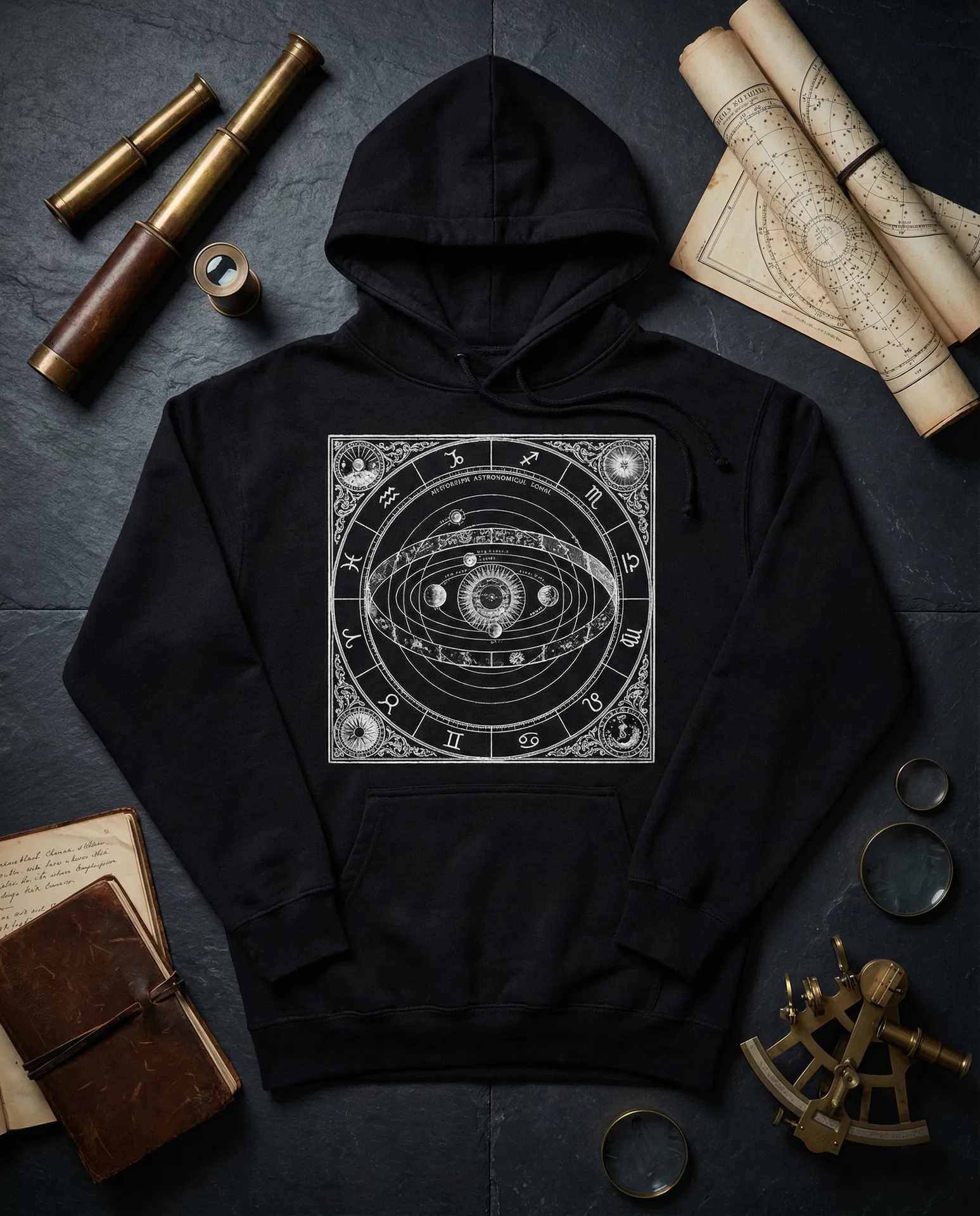
James Reynolds and the audacity of mapping the cosmos on a single sheet
The full title is A Transparent Orrery, or, Representation of the Solar System. James Reynolds published it in London in 1846, the same year Neptune was discovered — a fact that would have delighted him, since his diagram already showed the orbit of Uranus at the outer edge of the known system, and Neptune would have required him to add another ring.
The word 'transparent' in the title refers to the original format: the diagram was printed on thin paper or vellum so that it could be held up to a window, the light passing through to illuminate the planetary orbits, the zodiac ring, the comet paths. It was a teaching tool designed to be held in the hands, tilted toward the sun, made luminous by the very thing it depicted.
What strikes us about the Reynolds diagram, looking at it now, is the confidence of it. The solar system, in 1846, was not fully mapped. There were gaps, approximations, objects not yet seen. Reynolds drew it anyway — complete, ordered, beautiful. The orbits are clean ellipses. The planets are labelled in a clear hand. The whole thing radiates the Victorian conviction that the universe, properly examined, would turn out to be comprehensible.
We are not sure they were right about that. But we admire the ambition. The Systema Solaris Hoodie carries the full diagram across the chest — all the orbits, all the labels, the comet paths arcing outward. Wear the cosmos. Carry it quietly.
From the Collection
The print described in this entry is available as a garment, made on demand through Printify.
View the Garment